April 3, 2025 is approaching, and Trump:the self-styled master of everything:is about to announce a new tariff policy aimed at practically the entire world. Let us look at the event and ask what deeper logic may be hiding behind it.
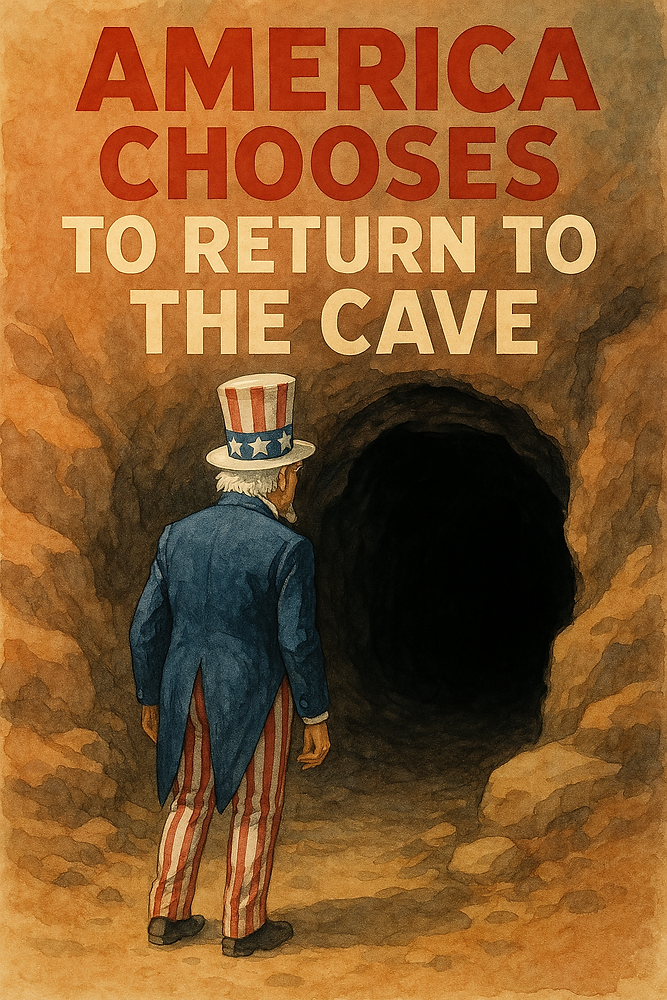
As usual, I will begin with a single sentence: America has chosen to retreat into its cave.
More specifically, Trump’s strange and chaotic tariff hammer appears to serve three broad purposes: securing votes from the MAGA base, confronting America’s worsening sovereign-debt crisis, and abandoning dollar hegemony.
First, we need to understand how Trump returned to power. On the world stage, he often performs like a clown. Yet within American domestic politics, and among a broad section of the public, he is treated as an immensely popular national hero:though what exactly constitutes the “nation” in a country like the United States is an awkward question in itself. Trump received roughly 77 million votes in the 2024 election, one of the largest totals in American history. Why? MAGA. Make America Great Again.
Why does MAGA resonate so strongly? Because Americans are not blind to what is happening around them: endless political correctness, endless illegal immigration and crime, endless conflict around Black Lives Matter. Many cities have been left chaotic and increasingly difficult to live in. These direct experiences of pain are both the spiritual origin of MAGA and the blade that returned Trump to the presidency.
But once an ignorant, shameless, and incompetent scoundrel had ridden public pain and expectation to the throne, he discovered that power and desire could not transform him into the Reagan-like president of his imagination:the leader who would revive America. Barely more than a month after taking office, he was surrounded on every front: foreign affairs, domestic policy, the economy, and the stock market. Confronted with comprehensive failure, Trump could only take another dose of the same drug: MAGA.
Every American pain, in this story, was caused by the rest of the world. America had done too much for everyone else, while everyone else owed America too much. And so, for MAGA, for America, and:more importantly:for himself, Trump would act like a true leader and fearlessly declare war on the world, much as Empress Dowager Cixi once did.
But is this really only about votes from the MAGA base? Of course not. That brings us to the second issue: America’s national debt.
The national debt is the sword of Damocles hanging above the United States. By the 2024 fiscal year, the US government’s annual interest expense on the debt had exceeded 886 billion:for the first time. That works out to roughly 1.2 trillion to 1.5 trillion. What does that mean? It is close to the annual economic output of Australia, around
The direct effect of tariffs is to increase government revenue. After the United States imposed additional tariffs on Chinese goods between 2018 and 2020, those measures generated roughly $30-50 billion in tariff revenue each year, according to US Customs and Border Protection. That revenue can be used to narrow the fiscal deficit and, in turn, slow the pace of new debt issuance.
The indirect effect is to adjust the trade deficit. If the deficit narrows, more money returns to:or remains inside:the United States. America can then reduce its dependence on foreign demand for Treasury debt and further reduce the need for new issuance.
Tariffs also place pressure on the Federal Reserve. Higher tariffs may raise inflation and force the Fed to increase interest rates. Higher rates would increase financing costs for businesses, weaken economic activity, and raise the government’s debt-servicing burden. But the Fed could also respond to recessionary pressure from the tariff shock by cutting rates earlier. Rate cuts would add to inflation, but they would also weaken the dollar and reduce the burden of interest payments.
Here is my prediction: Trump is betting on the second outcome. The Federal Reserve will most likely cut rates earlier than expected.
The Trump administration’s ultimate objective is to defuse the national-debt bomb:the threat that could truly destroy the United States:and it is prepared to pay almost any price to do so.
Which brings us to the third price: what happens to the dollar’s status as the world’s common currency:to dollar hegemony? The answer is simple. The Trump administration intends to give it up.
America’s trade deficits over many years were, in effect, deliberate. Without enormous trade deficits, there could not be enormous quantities of dollars circulating around the world. Without dollars being widely held, circulated, and used, there could be no dollar hegemony.
Trump’s coming program of broad tariffs will profoundly reshape international trade. Leaving the rest of the world aside, the policy’s ultimate objective is trade balance: a world in which American surpluses and deficits are roughly equal. The day that objective is achieved will also be the day dollar hegemony ends, because there will no longer be an excess supply of dollars circulating throughout the world.
At the same time, a contraction of American power and the productive pain of the country’s transition may cause the dollar to depreciate sharply, reducing the real burden of US debt. If the dollar retreats from global currency toward regional:or even primarily national:currency, the Federal Reserve would gain more room and more instruments with which to reorganize the American economy. Manufacturing returning to the United States through the tariff war would once again support domestic productivity and employment. The reconstruction of the domestic economy would then close the circle with the values of Trump’s MAGA movement.
To summarize: Trump came to power through populism with a national-debt bomb hanging above his head. For his personal dream and glory, and because of his own stupidity and selfishness, he has chosen to lead the United States away from its moral obligations and responsibilities:away from dollar hegemony, away from its allies, and away from hope.
America has chosen to retreat into the North American cave.
Suggested SEO description
Trump’s tariffs are usually read as protectionism. This essay argues that their deeper logic lies in MAGA politics, America’s debt crisis, and a possible retreat from dollar hegemony.
Publication presentation audit
- Native-opening check: the article begins directly with
April 3, 2025 is approaching, without an editorial preface or translation label. - Date provenance remains in Wix metadata and this rollback file.
- Superseded visible note, retained here for history only and not published:
English edition note : This essay was originally published in Chinese on April 2, 2025, at 16:10:47 CEST. This edition preserves the argument, figures, tone, and forecast as they stood at that moment. It is a translation, not a retrospective rewrite.