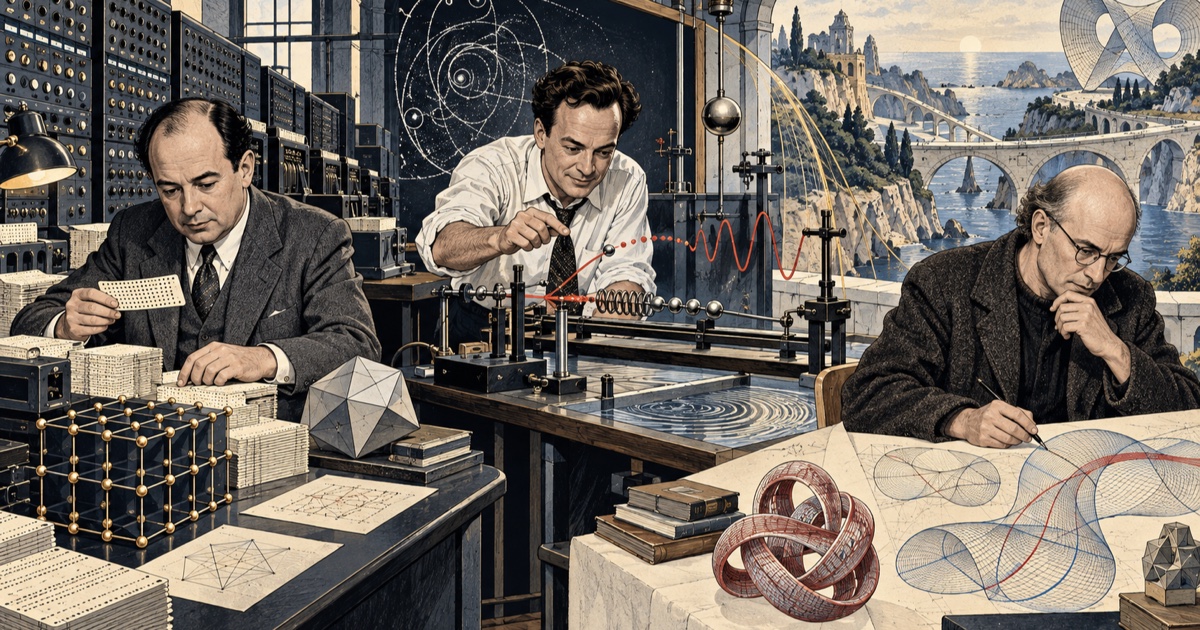
How the minds of von Neumann, Feynman, and Grothendieck worked on the world
We tend to imagine intelligence as a straight line. The stronger the memory, the faster the calculation, the higher the exam score, the farther up the line someone stands.
That scale can measure ordinary abilities, but it struggles to explain truly rare minds. At the extremes of human cognition, the difference is no longer just speed or capacity. Different people may use entirely different internal structures to understand the world.
Von Neumann, Feynman, and Grothendieck all occupied such extreme positions. But they were not three versions of the same kind of genius.
Von Neumann displayed an almost universal capacity for processing information. Feynman turned abstract relations into physical mechanisms that could be set in motion. Grothendieck rebuilt the theoretical space in which objects, relations, and problems themselves could exist.
They faced the same complex world. What happened inside their minds was altogether different.
Von Neumann: When the World Becomes a Set of Computable States
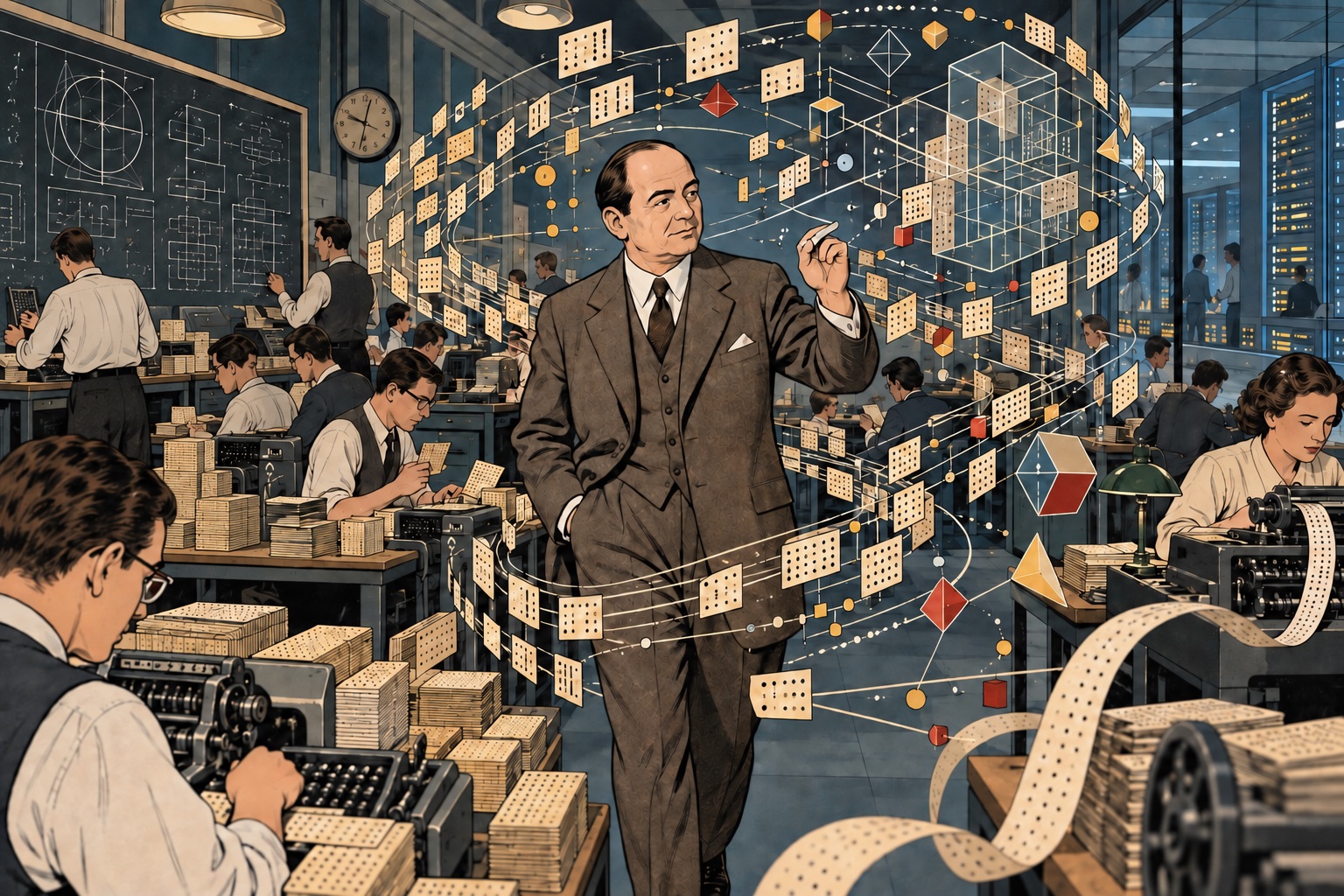
When people speak of von Neumann, they often focus on his memory and the speed of his mental arithmetic. Those abilities were astonishing, of course, but they may have been only the surface.
His more fundamental ability was to turn a complex problem rapidly into a set of states that could be worked with.
Numbers, logical conditions, strategic branches, geometric relations, and possible future outcomes could all be held within one internal space. He did not have to stop as often as most people do to recover a condition that had fallen out of view. Many relations remained accessible at once, allowing him to move through them at speed.
For most people, complexity creates a cognitive burden. As information accumulates, working memory becomes crowded, and local reasoning loses contact with the whole. Von Neumann seems to have been able to organise that complexity directly. He did not bypass the details. He brought large numbers of them into a precise computational structure at the same time.
Such a mind can cross disciplinary boundaries with ease. Once a problem can be formalised, it can enter the same processing system. Mathematics, physics, engineering, game theory, and computer design belong to different fields from the outside. Internally, they may be different expressions of structures of states.
To borrow the language of today's technology, there is something about von Neumann's thinking that resembles a general-purpose artificial intelligence. This is not a claim about whether machines have consciousness. It is an analogy for a wide-ranging processing capacity: high throughput, powerful working memory, rapid switching, and precision maintained throughout.
The form of intelligence he represents is an extreme expansion of computational space.
Feynman: Equations Have to Move in the Mind
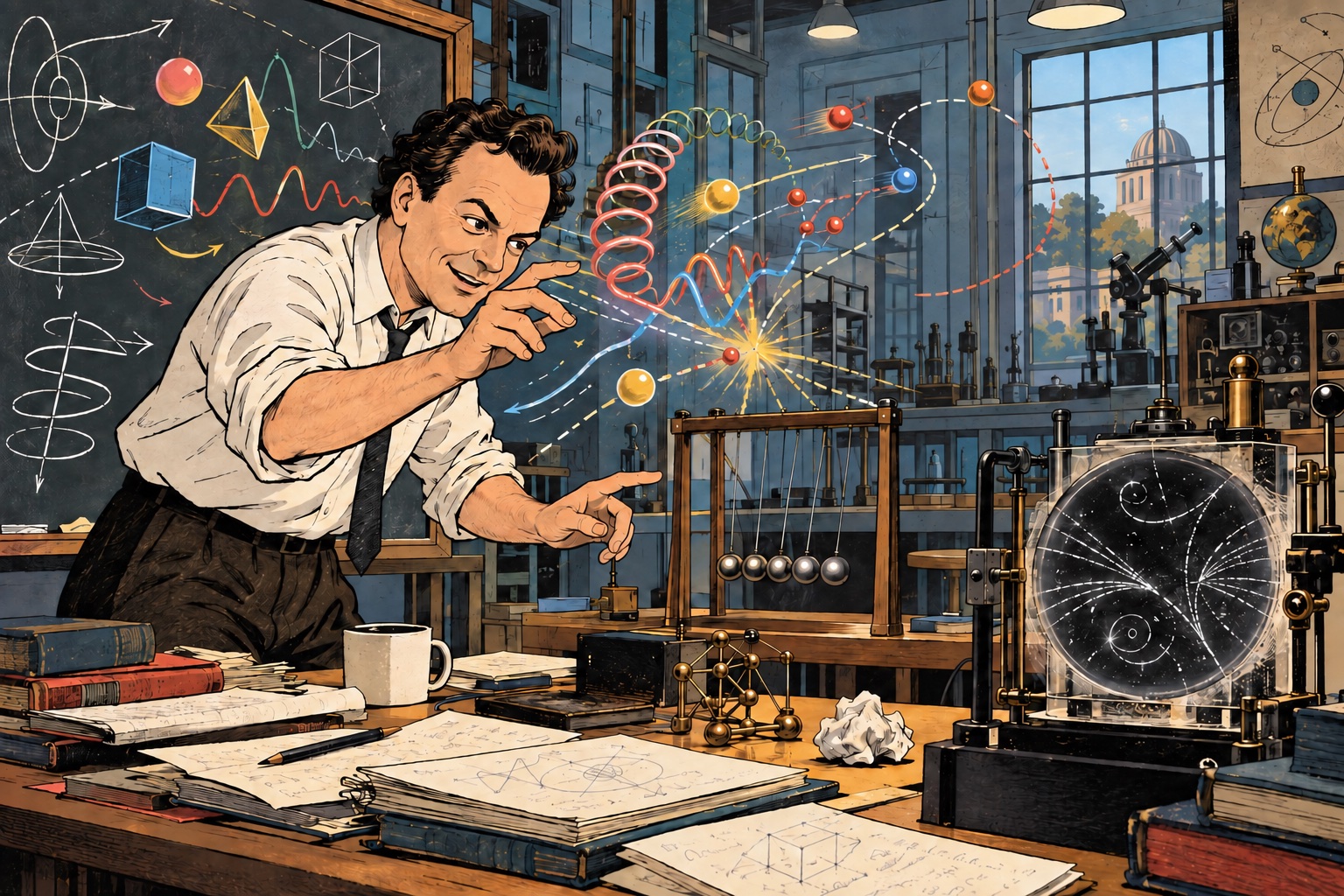
Feynman's thinking feels quite different.
Once an equation entered his mind, it did not remain on the page. It became motion, shape, direction, collision, and change.
When most people look at an equation, they first see its symbols and wonder which rules should be used to rearrange them. What Feynman saw was more like an actual process. Objects were moving, waves were spreading, particles were interacting, and a local change was propagating through a system.
His physical intuition was not a vague feeling detached from mathematics. It was a highly compressed form of dynamic computation. That computation did not always have to proceed as a sequence of symbols; it could also appear as a physical model running continuously in his mind.
Once the model began to run, changing one condition would change the other parts as well. Understanding was therefore no longer a matter of remembering a formula. It meant knowing why the system moved as it did and what it would become a moment later.
This also helps explain the penetrating force of a Feynman-like understanding. He was not content to know the name of a concept or to repeat the standard answer. He wanted the concept to touch the reality it was meant to describe again.
When abstract symbols lose their connection with concrete mechanisms, knowledge can easily turn into a game played with words. Feynman kept pulling symbols back into a world in motion. The test was not whether a statement sounded right, but whether it could actually run inside his internal model.
Von Neumann's mind was like a computer able to process a vast space of states. Feynman's was more like a finely tuned simulator.
In the first structure, complexity is organised and computed. In the second, abstract relations acquire time, motion, and causality.
Grothendieck: Rebuilding the Space in Which the Problem Exists
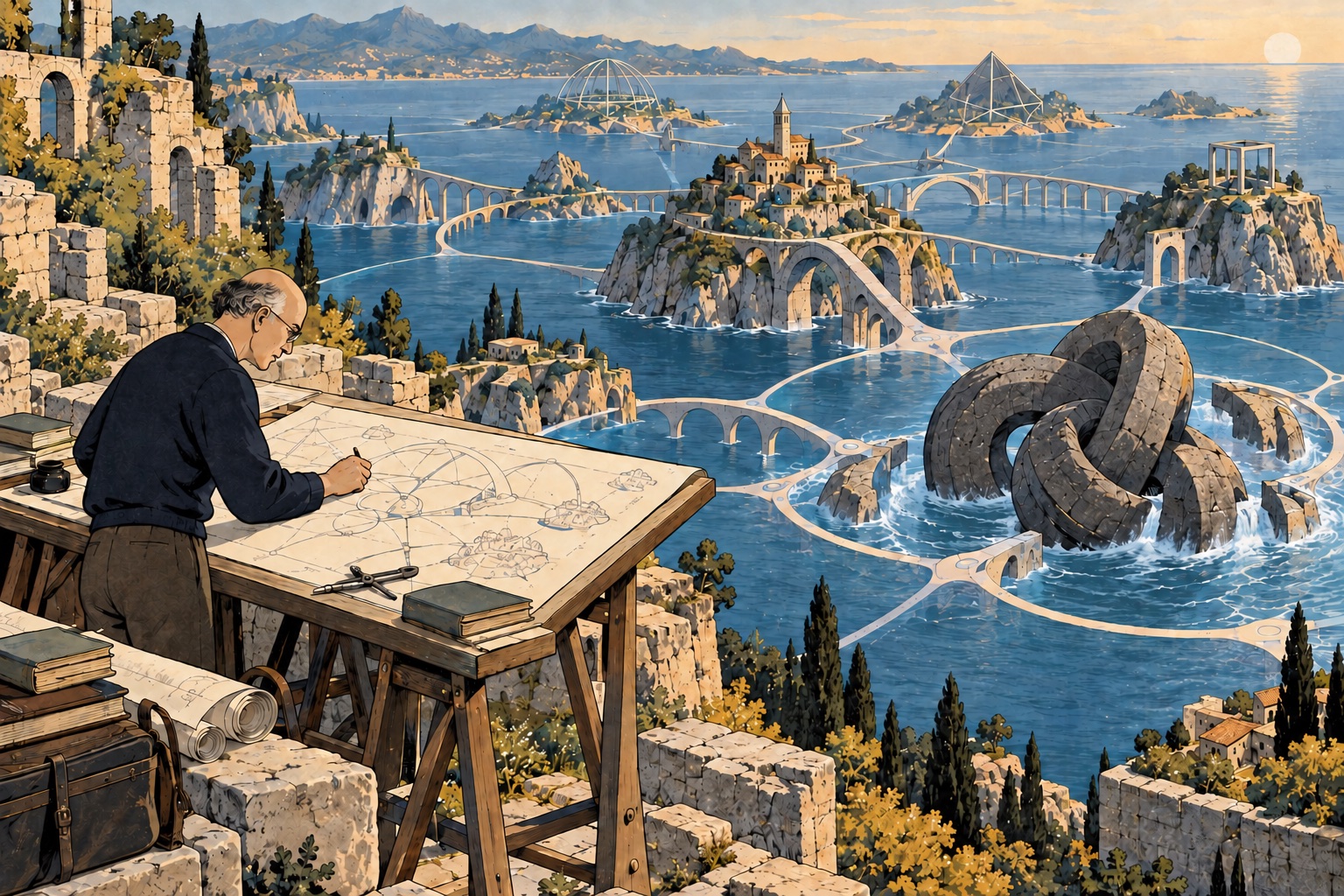
Grothendieck represents yet another form of intelligence.
Faced with a difficult problem, most people look for a better way to solve it. Someone more capable might invent a new tool, find an elegant proof, or discover an opening that no one had noticed before.
Grothendieck often went further. He would re-examine how the objects in the problem had been defined, why their relations had to be expressed in a particular way, and whether the existing language had made an essentially simple structure difficult to see.
If the original theoretical space was too narrow, he enlarged it. If the existing objects could not reveal the real relations, he redefined them. If several fields were connected in a way that had not yet been expressed, he created a language capable of holding them together.
This was more than solving a problem.
He changed the way the problem could be posed.
Imagine a mathematical difficulty as a tightly tied knot. The usual approach is to find more skilful fingers and work the knot loose, little by little. Grothendieck was more like someone studying the relation among the rope, the knot, and the space around them. Once he changed that surrounding space, the knot that had seemed so tight might loosen of its own accord, or reveal itself as one local form of a larger structure.
Work of this kind often solves more than a single problem. Once the theoretical setting has been reorganised, many apparently unrelated problems can be expressed in new ways.
A Grothendieck-like mind therefore has a slow but far-reaching power. It need not attack an obstacle directly. Instead, it keeps widening the background until the obstacle loses its original shape.
Von Neumann processed a vast space of states at high speed. Feynman made abstract relations into physical processes that could run. Grothendieck rebuilt the space in which states, objects, and relations could appear at all.
Intelligence Has No Single Highest Form
Comparing these three people does not yield a simple ranking.
If a problem demands that many conditions be grasped in very little time and reasoned through precisely, a von Neumann-like structure may have an overwhelming advantage.
If the heart of the problem is to discover a real mechanism and distinguish formal derivation from physical understanding, a Feynman-like internal simulation can be extraordinarily penetrating.
If the difficulty lies in the conceptual space itself, and existing language already limits what can be understood, then a Grothendieck-like reconstruction of the framework may be what truly changes the situation.
Their differences show that intelligence is not a single resource. Speed of computation, dynamic simulation, and the creation of frameworks cannot be compressed into one score.
A mind at the peak of its powers does not necessarily execute existing methods better. Sometimes it has a larger internal space. Sometimes it can make an abstract world genuinely move. Sometimes it recreates the language with which human beings think about a problem.
The summit of intelligence, then, is not one position.
Several entirely different structures exist there.