
Anthropic publicly named Chinese AI companies, alleging that they used large numbers of accounts to call Claude and "illegally extract" its capabilities to train their own models.
This accusation has two fundamental problems. It crosses an evidential boundary, and it does not establish what is illegal.
1. Seeing API calls does not prove what users did with the outputs
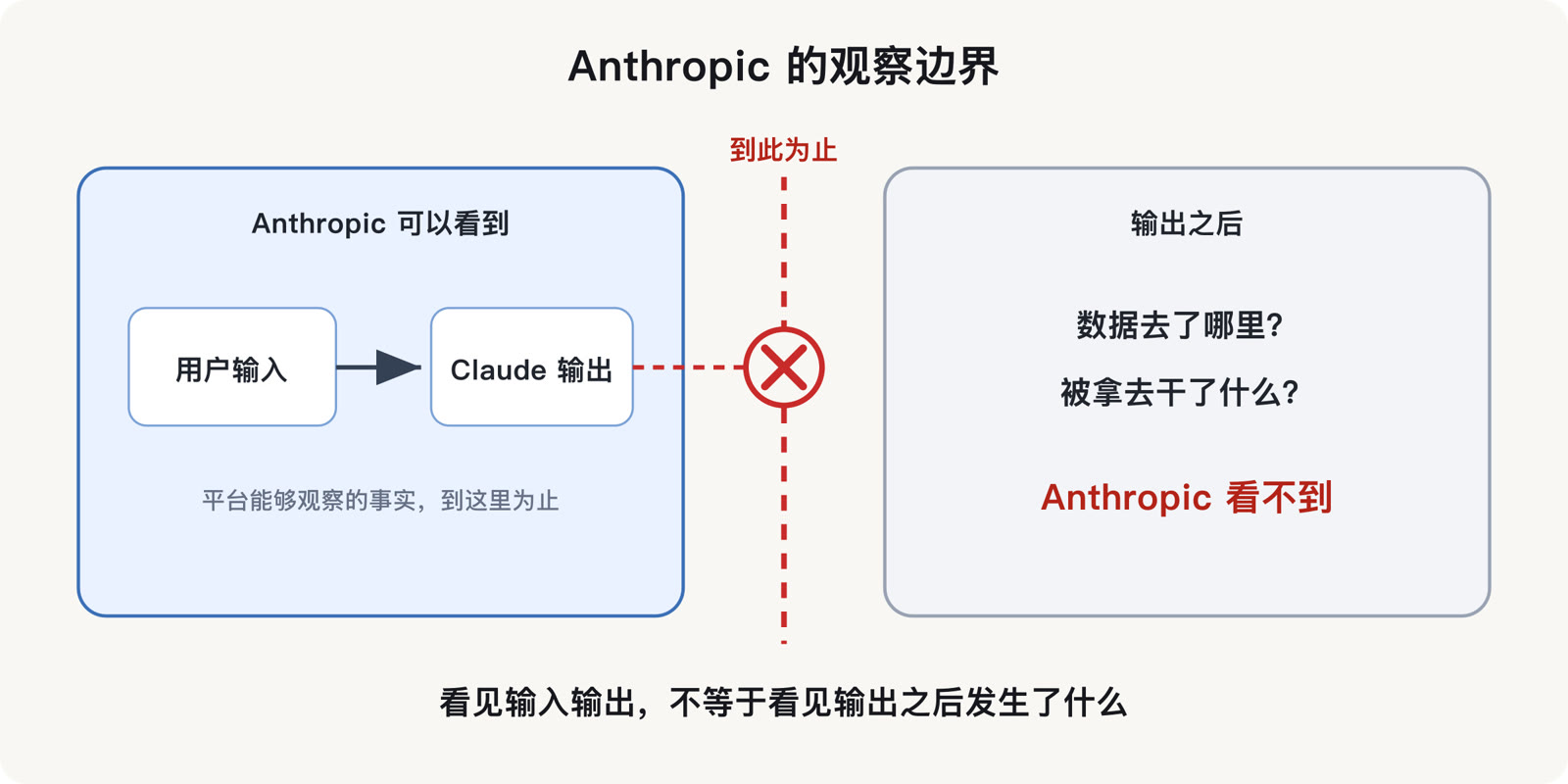
What Anthropic can directly see is what users submitted to Claude and what Claude returned. IP addresses, accounts, payment methods, call times and prompt patterns are also only service logs from Anthropic's side.
Whether an output was saved after leaving Claude, entered a training dataset, contributed to a weight update or improved another model would all take place within the user's own systems.
Anthropic is a private company, not a court or law enforcement agency. Without the other party's permission or a formal legal process, it has no right to obtain the internal training logs of Chinese competitors. Nor has it explained any lawful route by which it could cross that systems boundary to gather evidence.
So when it infers from platform logs that a particular company trained Claude outputs into a specified model, the problem is more basic than insufficient evidence. The conclusion does not follow from what it observed.
Automated evaluations, stress tests, model comparisons, proxy services, third-party activity and account impersonation could all produce similar patterns of calls. "Distillation might produce this pattern" does not mean "only distillation could produce it," still less that a named company has trained the outputs into its own model.
Anthropic saw the beginning, did not see the process and announced that it knew the ending. Its claim of "high confidence" is nonsense.
What is more alarming is the implication for everyone else. If this reasoning were accepted, any user could be the next accused party. Today Anthropic can point to usage patterns and accuse a Chinese company. Tomorrow it could use the same method against a startup, research institution or ordinary developer, saying their use of its outputs amounted to "distillation" or some other suspicious activity.
Anthropic may manage its platform and suspend accounts. It cannot turn its right to observe its servers into a right to presume what users do and publicly judge them. In other words, how I use output data is my business. What gives Anthropic the right to pronounce on it? If it truly knows what I did with that data, then I have another question: was Claude being used to spy on me?
2. Even if distillation took place, where is the illegality?
Even if, for the sake of argument, Anthropic had proved that distillation occurred, it would not thereby have proved a crime or other illegality. Anthropic itself acknowledges in its statement that distillation is a widely used training method and is lawful in itself. Users also hold the copyright in AI output content, so why would distillation itself be illegal? AI-generated output and human-created work are not the same thing under the law. I am referring here to the American legal system; interested readers can examine US judicial interpretations and cases for themselves.
Anthropic can prohibit customers from using Claude to train competing models in its terms of service. If it can prove that a customer bound by those terms breached a specific provision, it can suspend the account, terminate the contract, pursue arbitration or seek damages.
But a possible breach of service terms is not the same as theft, infringement or a crime.
If Anthropic claims unauthorised access, fraud or infringement of a specific right, it should separately prove who acted, what they did, what law applies and the full chain of evidence. It cannot simply attach the word "illegal" to "distillation" and then use the phrase "illegal distillation" as proof of illegality.
Terms of service are not a criminal code. An internal classifier is not a court. Request metadata is not a training log. A company statement is not a judgment.
Anthropic does not know what happened on the user's side, yet acts as though it does. It has not established illegality, yet has already pronounced guilt. It sells API access while trying to claim permanent authority to interpret users' downstream behaviour.
Users have no reason to keep giving their data, business and trust to a company that turns service logs into accusations and treats terms of service as though they were a legal verdict.
Boycotting Anthropic is everyone's responsibility.