
Reading at the scale of a page, modelling with equations and recognising structural parallels quickly
I realised quite early that I take in information differently from many people.
Calling it fast reading, a good memory or strong comprehension does not capture the difference. Those terms describe results without explaining what happens inside.
To describe my intelligence accurately, I need to see it as a system in operation.
From a small amount of information, this system rapidly builds a model. The model generates predictions before all the input has arrived, and those predictions are compared with what actually appears. Information that fits is absorbed quickly; a discrepancy immediately draws attention. At the same time, I condense physical or abstract phenomena into equations, curves and dynamic models, then map structures from one field onto another.
Understanding does not wait until I have finished collecting information. It takes part in how I collect it.
I do not take in a page sentence by sentence
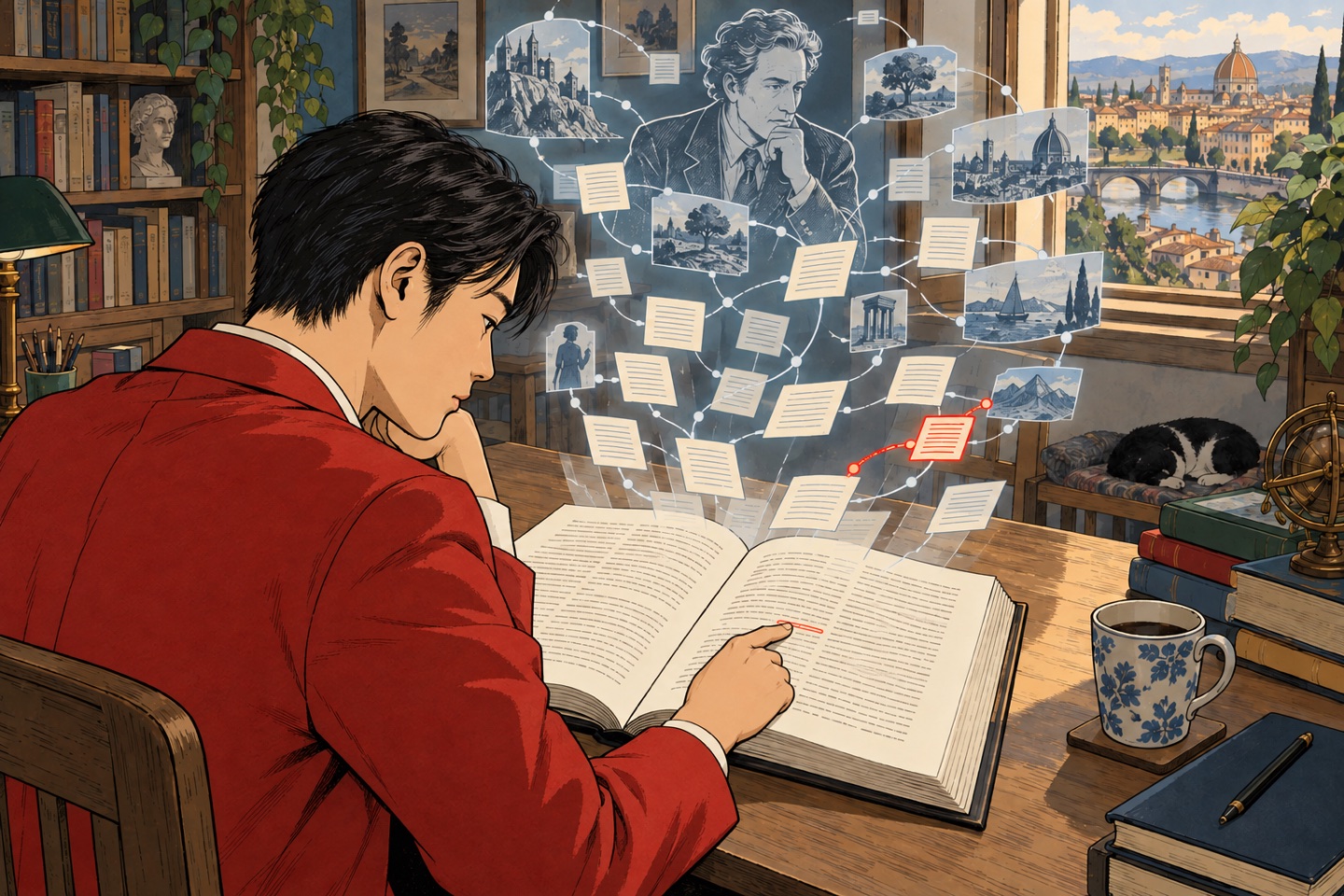
The usual model of reading is linear. A reader finishes one sentence, understands it and moves to the next. The information in a paragraph is processed in sequence until it forms an understanding of the whole page.
That is not how it works for me.
I can take in information at something close to the scale of a page. What my eyes meet is not merely a chain of sentences to decode one after another. I see several structures at once: the distance between concepts, the direction of an argument, repeated words, the centre of gravity of paragraphs and the position of a local detail within the page.
This does not mean I give every word equal attention. My attention is distributed very unevenly.
The parts that the model can explain are compressed quickly. What really needs processing is what the model could not have generated in advance.
Reading at page scale, then, is not simply sentence-by-sentence reading sped up. It uses a different way of selecting information. Most of the text confirms a structure; a few discrepancies change it.
I first generate an author in my mind
As I begin reading, I quickly build an internal model of the author.
I want to know more than what the author wrote. I naturally infer how they divide up the world, which concepts sit at the centre of their system, which assumptions they take for granted and why a particular judgment emerges from their structure.
As I read on, the model gradually becomes capable of generating its own continuations.
It starts predicting what the author will discuss next, how they will organise the argument and where they may change direction. The original text and my internal model move forward together; I keep comparing the two.
When a prediction matches the text, I have gained more than a conclusion. The match shows that I have grasped part of the rule that produces that conclusion.
This is one reason I can read quickly. I do not need to treat everything as separate new information. Material already generated by the internal model can be confirmed in larger blocks.
So when I read a book, what remains is often more than a memory of the book. I come away with a system that can continue thinking.
A discrepancy tells me more than repetition
The most important moment in this process is usually not when a prediction succeeds, but when it fails.
If the author suddenly uses a concept that does not fit the established structure, changes the argument's direction or makes a judgment my model did not generate, that discrepancy stands out immediately from the surrounding information.
My attention stops there.
I return to the relevant paragraphs to check whether I missed a condition or whether the author's structure is more complex than I thought. Sometimes the discrepancy only calls for another local variable. Sometimes it forces me to rebuild the whole model of the author.
For that reason, close reading is not determined by how difficult the words appear to be. Prediction error triggers it.
I may move quickly through a passage that others find famously hard because it still falls within my model's explanatory range. Conversely, an ordinary-looking word can make me stop because it exposes a crack in the structure.
To me, a discrepancy is not an interruption to reading. It is the most valuable information in it.
I rapidly turn phenomena into equations and curves
Modelling does not happen only when I work on physics. Whether I am reading, thinking or expressing an idea, I soon do the same thing: condense what I am looking at into an internal model that can run.
The phenomenon might be physical or abstract. Once it enters my mind, it often stops being only a passage of language, a set of observations or a vague impression. I quickly identify its variables and relationships and turn it into an equation, or a curve produced by an equation.
The images I mean are usually not pictures of what an object looks like. They are images of equations. I see how one quantity changes with another and what state the relationship as a whole is in. The conversion happens so quickly that the image is not an illustration added after reasoning. It is part of the understanding itself.
Nor is the equation I see necessarily static. It may be a dynamical equation. I can continue running, in my mind, how a state changes over time, how a curve shifts when a condition changes and how the system will evolve next.
So when I think, I am often watching how a model changes. When I explain something, I am often describing the equations, curves and motions I have already seen. Language unfolds that internal model so another person can follow the relationships I saw.
For me, modelling does not replace reality with symbols. It condenses scattered observations into something with a state, the capacity to change and a future that can be explored. I do not first understand a phenomenon and then look for an equation. Often the moment it becomes an equation or curve is the moment I understand it.
Physical relationships become animations in my mind

This conversion into equations and images becomes especially concrete when I work on physics.
Force, velocity, trajectories and boundary conditions do not exist for me only as symbols. They enter a continuous dynamic scene. I can see internally how an object moves, how variables change and how a local change affects the system's next state.
By "see" I do not mean a still picture.
A still image preserves one instant. My model has a time axis. It can run forward, and it can run again after a condition changes. Change one variable and other relationships adjust; future states unfold along a new trajectory.
Equations and animation are not two separate tools for me. Equations condense relationships; animation unfolds those relationships through time. I can move from curve to motion, then from motion back to equation to check whether the model is accurate.
This way of thinking means I am not easily satisfied by merely knowing how to use a formula. If it cannot produce states and changes in my mind, I still feel I have not truly understood it.
Understanding has to be able to run.
I look for the same structure across different fields
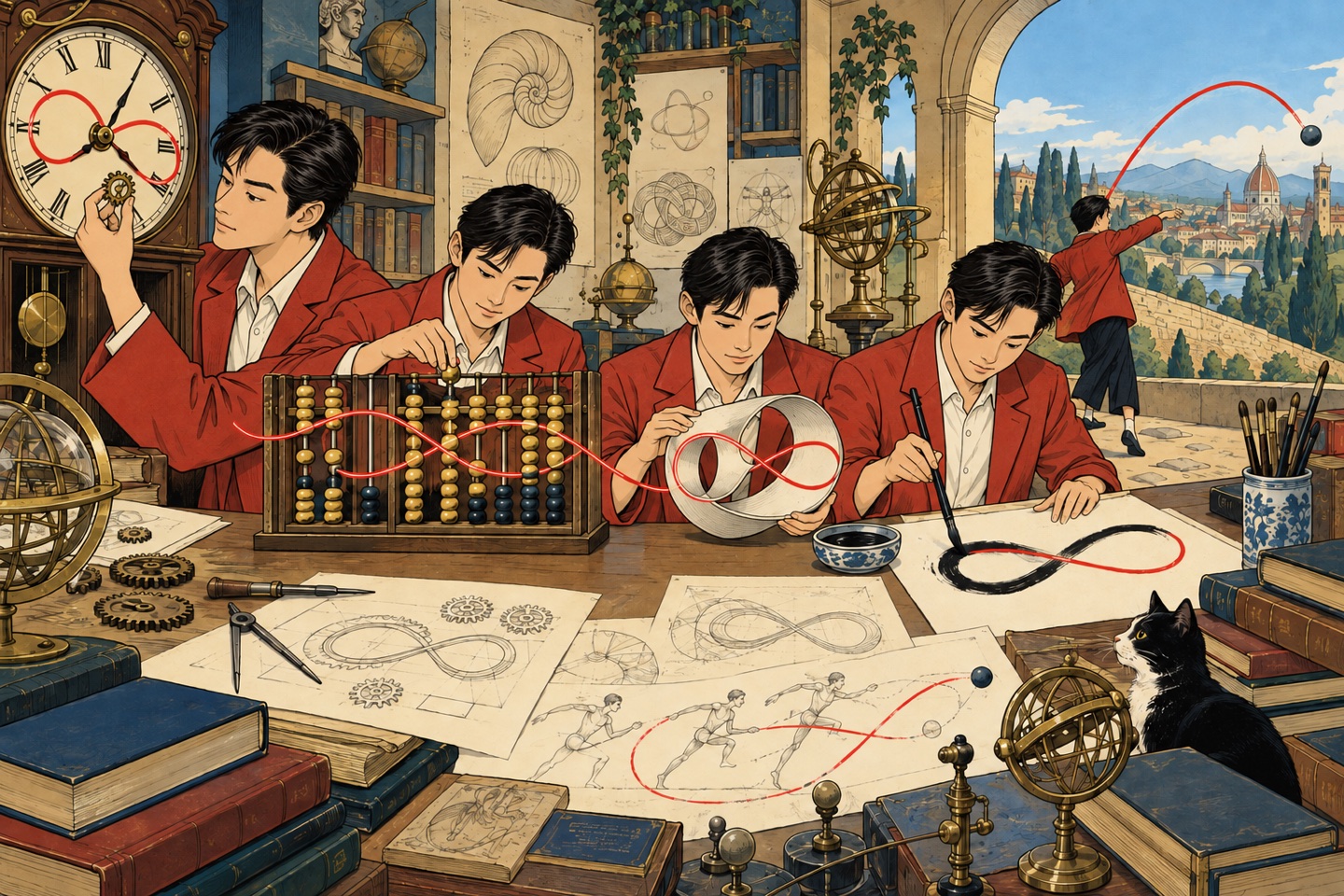
Another recurring feature of my thought is that I quickly recognise shared structures among things that appear unrelated.
Systems of timekeeping, number systems, topological relations, calligraphic strokes and physical trajectories are far apart in conventional subject classifications. Once they enter my mind, those subject boundaries temporarily move into the background. I first attend to how the relationships are organised.
What remains invariant under a transformation? How does a local operation affect the whole? Which parts form boundaries, and which make connections? Can one system be mapped onto another while preserving the original relationships?
When such a correspondence holds, understanding from one field can enter another.
This differs from association in the ordinary sense. An association may rest on similarity of colour, shape or mood. A structural correspondence requires the relationships to match. What matters is not that one object reminds me of another, but whether two systems share the same skeleton.
This ability lets me pass through the surface language of different fields and reach their generative rules directly.
A new field is therefore not necessarily an unfamiliar world in which I must start from zero. Once I find a mapping to a structure I already know, many relationships can transfer quickly.
These abilities belong to one system
Taking in information in parallel at page scale, modelling an author, noticing prediction errors, building equations, seeing dynamics and finding structural parallels across fields may look like separate abilities.
For me, they come from one basic tendency. I do not treat incoming material as a pile of facts waiting to be stored. I look for the structure that can generate it.
Building a model of an author means finding the generative structure behind the writing.
Turning a phenomenon into equations and curves means finding relationships between variables and rules of changing state.
Making a physical process move means unfolding those relationships through time.
Recognising structural parallels across fields means finding the relational structure on which different objects depend.
Expression means unfolding an internal model that is already running into language.
Page-scale reading is possible for the same reason: a generative structure compresses much of the predictable information. Attention need not be spread evenly over every word. It can focus where the model fails.
The whole process can be summed up this way:
Input arrives and relationships condense into equations, curves or another internal model. The model begins to run and generates predictions. Real input tests those predictions. Discrepancies alter the model. The updated model keeps running.
This is not understanding that happens once and stops. It is a continuous cycle.
Intelligence is a model that continually rewrites itself
From the outside, my reading may seem fast. My understanding across fields may look like a leap, and my physical intuition may be dismissed as imagination.
None of those labels reaches the core.
What is really happening is that my mind is constantly generating an internal version of the world. It often takes the form of equations, curves or dynamic scenes. It runs in my mind before being tested against real input. When predictions succeed, the structure is confirmed. When they fail, the model changes at the point of discrepancy.
I do not passively wait for the world to leave an impression on me.
I reconstruct it internally, run it, then learn about it anew wherever it refuses to follow the prediction.
That is the central way my intelligence works.