
Recent work involving Claude in the formalization of Fermat’s Last Theorem has renewed discussion of the cognitive capabilities of large language models. One question worth pursuing is whether, when a system can work with knowledge from a broad range of fields, the connections within that knowledge might allow it to reach deeper levels of abstraction.
This question can be approached through both the behavior of large language models and observations of an individual’s cognitive processes. These perspectives concern, respectively, how knowledge is organized within a model and how a person draws on existing experience to establish new connections. Bringing them together offers points of reference for understanding abstraction across domains.
If we imagine the entire system of cognition as a sphere, we can call the point at its center the “truth core.” This point is analogous to a singularity. Here, it represents a hypothetical common generative source: regularities and phenomena in different fields unfold outward from it and appear at different levels.
Within this conception, mathematical theorems, physical phenomena, and everyday experiences all contain manifestations of some deeper structure. Different disciplines and research methods operate primarily at different levels and in different regions of the sphere. Its spatial relationships describe levels of cognition: exploration within a particular field and the deepening of abstraction through connections across fields may follow different paths.
“Working backward” here means starting from specific manifestations and progressively abstracting more general relationships, one level at a time. Phenomena that remain separate within one field may find a common explanation at another level of abstraction; regularities established independently may also become part of a deeper shared structure through new connections. If those connections do reflect common generative relationships, this process can be understood as moving closer to the truth core.
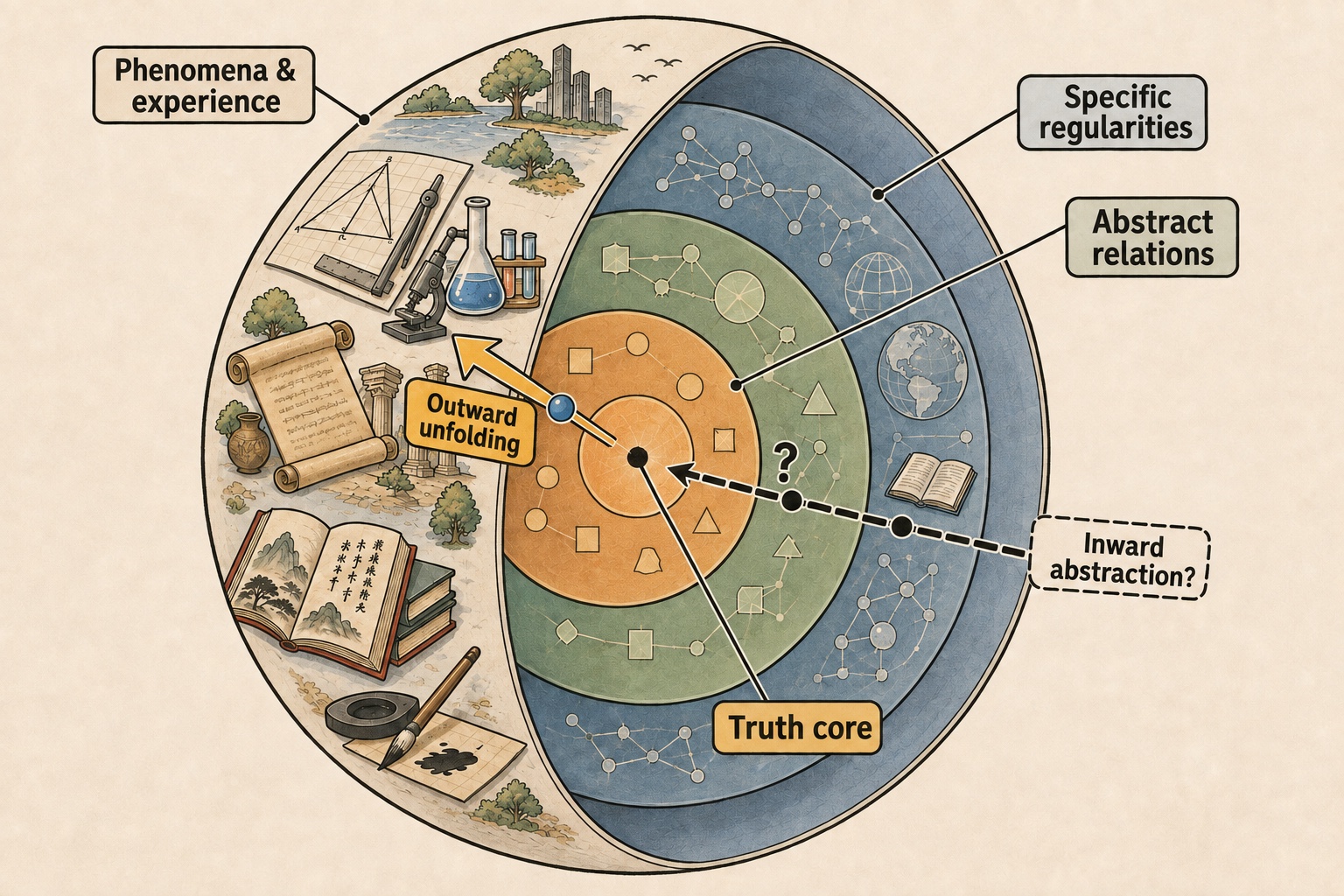
Within this conception, deeper cognition should correspond to stronger analytical and predictive capabilities. Understanding the relationships behind something helps explain why it appears and how it might develop as conditions change. The capabilities associated with moving toward the core are therefore primarily the analysis of phenomena and the prediction of future changes.
The role of knowledge across domains can be illustrated with a hypothetical example. A mathematician may have a deep understanding of a particular specialty without a comparable understanding of chemistry, history, or poetry. With deep knowledge of these fields as well, the mathematician might discover relationships that were previously unavailable to draw upon. Some of those relationships might, in turn, offer new ways to express or reason through existing mathematical problems.
The change here concerns how different bodies of knowledge are organized in relation to one another. A relationship that is difficult to discern in one field may be easier to recognize in another; understanding on one side may also help reorganize a problem on the other. Yet an individual’s time, energy, and capacity for knowledge are limited. It is difficult to keep bringing deep knowledge of a wide range of fields into the same process of thought.
Self-observation offers another point of reference for this conception. Papers, novels, poems, and code appear externally as different kinds of work, yet they may arise from the same person’s internal cognitive structure. This suggests one possible interpretation: external works are expressions of an internal system through different media, and may reveal only part of that system. The range of visible works does not encompass the full range of internal cognition.
The relevant self-research materials record two specific instances of connections across domains. One is a language-learning note published in 2019: the German expression for 2:30 helped the writer understand the relationship between the “half three” construction in a Danish numeral and its base-twenty structure. At the time, the writer could not yet pronounce that Danish word, but had already understood its construction through the structure of another language. What carries across here is a way of structuring numbers.
The other example applies topology and fractal geometry to the analysis of calligraphy. Topology offers an entry point for understanding how a character’s structure is preserved, while specific problems in calligraphy call for further distinctions among the geometric arrangement of a character, the qualities of brushwork and ink, and the movement of the brush. In particular, the medial axis of a glyph’s outline is a geometric object, whereas an actual handwritten stroke involves movement through time. This distinction expands the question from static shapes to the relationship between shapes and the processes that generate them.
These two sets of materials present a process that can be studied further: existing knowledge contributes to understanding another field, while the new object of study changes how the original problem is expressed. Self-observation can trace the associations, reorganization, and revisions involved, offering concrete clues to how connections across domains affect abstraction. These observations of an individual’s internal cognitive structure provide a reference, at the level of process, for the conjecture outlined above.
Large language models bring the question of connections across bodies of knowledge into a wider setting. A single model can process knowledge and forms of expression from multiple fields. If transferable relational structures can form among these materials, the model may use them to understand problems that were previously treated separately and develop new paths of reasoning.
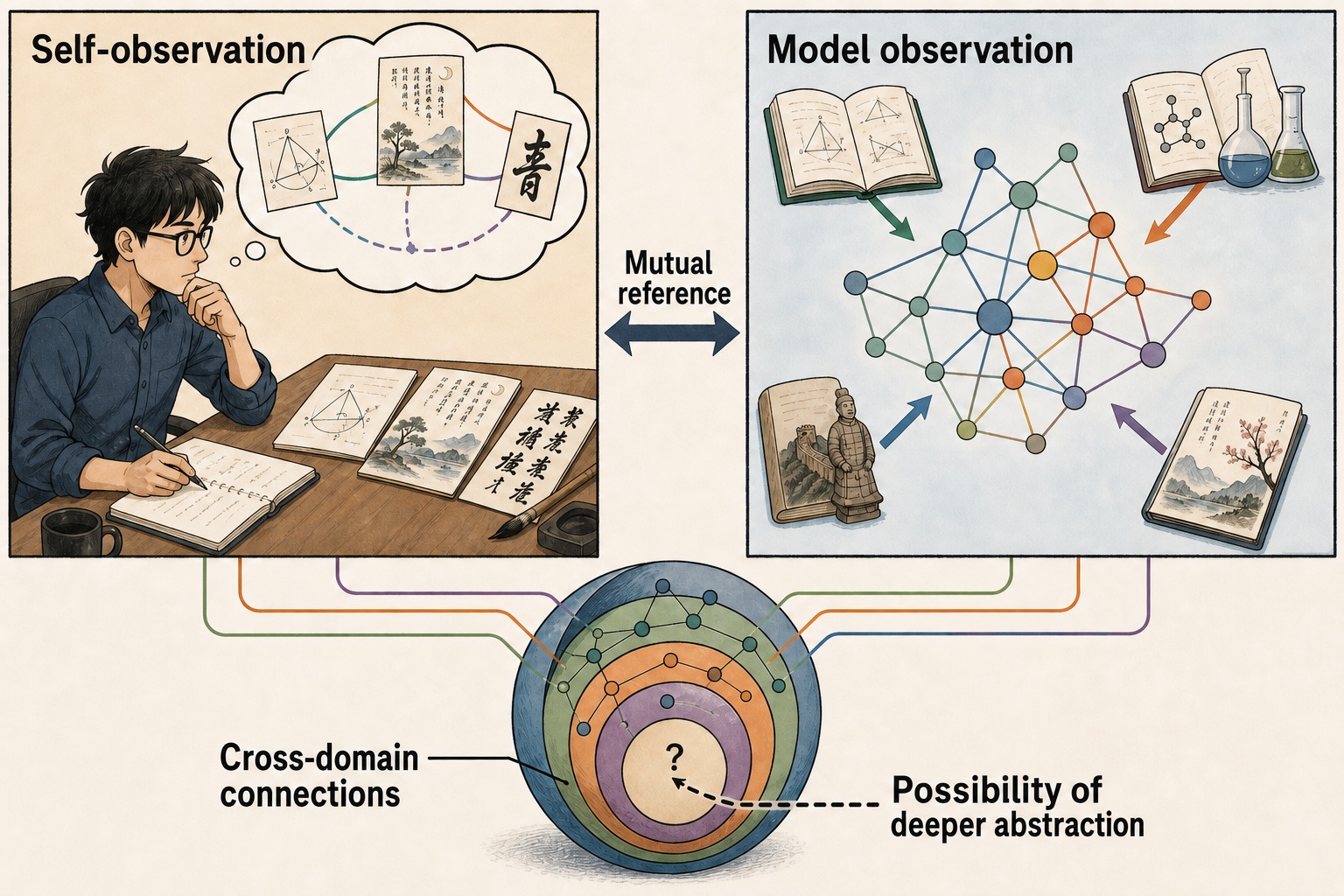
The question about emergence here is whether connections across bodies of knowledge can produce capabilities that are difficult to discern directly from isolated pieces of knowledge. Increases in model size and knowledge coverage provide conditions for this possibility. The process leading from broad knowledge to the organization of relationships, and then to deeper abstraction, remains to be understood. Growth in the amount of knowledge and the range of outputs needs to be considered separately from the deepening of abstraction.
An explanation of a large language model’s capabilities that stops at “exposure to a vast amount of material” therefore leaves open how that material is organized internally. Describing only the final output likewise does not explain why different problems can be addressed through some common relationship. Abstraction across domains concerns precisely this process of organization between knowledge coverage and specific manifestations of capability.
Self-observation and observation of models can correct one another here. The former offers clues to the processes through which a person establishes connections, forms expressions, and revises their understanding; the latter shows what happens when broad knowledge contributes to a task. Individual experience can help frame questions about models, while a model’s behavior may prompt an observer to reconsider their own cognitive processes. This comparison does not presuppose identical internal mechanisms.
If large language models can extend the range of connections across bodies of knowledge and help form deeper abstractions, then using them to approach the truth core from more directions becomes a possibility worth discussing. Relationships that an individual could not previously consider together can enter a single process of exploration. Some problems constrained by disciplinary boundaries may thereby acquire new entry points.
Whether it is possible to work inward from outward manifestations, however, remains an open question within this conception. Even if different phenomena are assumed to share a common generative source, it does not follow that observing them is sufficient to recover the corresponding generative relationships. A common explanation established through abstraction may still be some distance from the hypothetical truth core.
Another possibility is that large language models help construct a highly coherent system of cognition. Large amounts of knowledge become interconnected within it, and disparate phenomena receive a unified explanation, yet that unity may hold only within the system. The resulting sense of “approaching the core” does not necessarily mean that a path back to the truth core has been established.
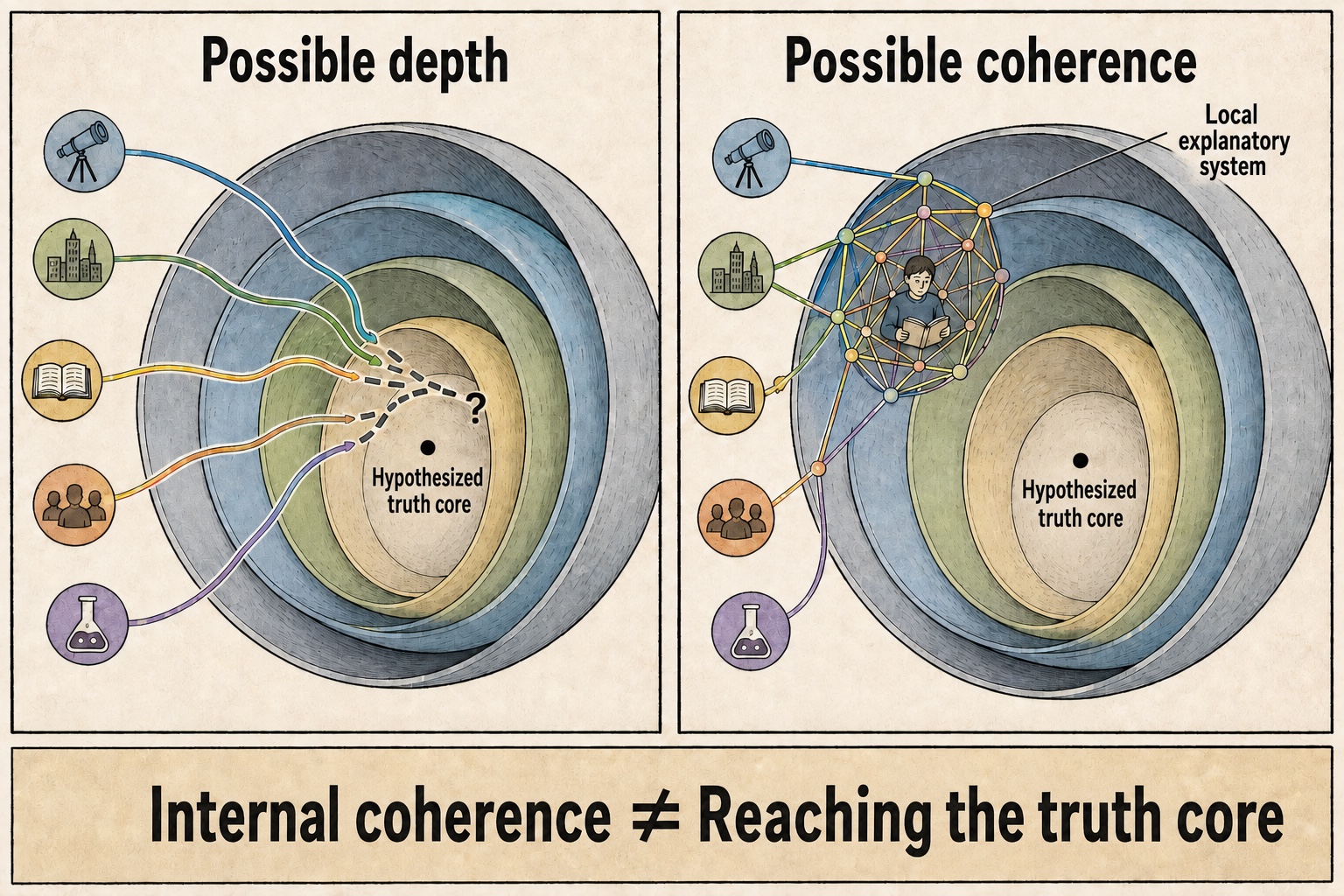
This gives rise to the concern about binding ourselves in a cocoon of our own making. If a cognitive system’s internal coherence is mistaken for proximity to the generative source of things, a complex and persuasive explanatory system may itself become a constraint on cognition. The richer the connections across domains, the more compelling this coherence may become. Whether it corresponds to deeper understanding remains a separate question.
The conjecture leaves these questions open: can large language models, through connections among broad bodies of knowledge, help cognition move inward one level at a time? In that process, how can a deeper understanding of generative relationships be distinguished from a cognitive system’s growing internal coherence?