In July 2026, Elon Musk gave The Economist’s editor-in-chief, Zanny Minton Beddoes, a strikingly optimistic account of the future. AI and humanoid robots, he said, would create an almost unlimited supply of goods and services. Work would become an optional pursuit, much like gardening, and money might eventually lose its meaning. He called it an "age of extreme abundance."Full interview transcript
It is a future worth hoping for. But the argument may confuse two very different forms of prosperity: absolute wealth and relative wealth.
Abundant production, unanswered distribution
Musk’s argument runs like this: if AI and robots can supply more goods and services than humanity can consume, people will no longer need money. It is a short step from there to believing that poverty and the wealth gap will cease to matter.
But greater productive capacity does not automatically produce equal outcomes.
AI can drive the marginal cost of goods very low, and robots can replace human labour at scale. Neither change answers the more basic question: who owns the AI, robots, computing power, energy, land and infrastructure that produce those goods and services?
If that ownership remains highly concentrated, material goods can become more plentiful while wealth becomes even more unevenly distributed.
Abundant production can reduce the scarcity of reproducible goods and services. It cannot abolish scarcity itself. Prime land, other people’s time and attention, unique experiences, social status, political influence and control of the productive system cannot be copied without limit. As long as those things remain scarce, distribution, comparison and power will remain with them.
Wealth is better measured as a share
In my 2023 essay "Rethinking Wealth" I argued that a better measure of a person’s wealth is not the amount of fiat currency they hold, but their share of society’s total wealth.
Relative Wealth = Personal Wealth ÷ Total Social Wealth
Suppose AI increases society’s total wealth a hundredfold while the wealth available to an ordinary person rises only tenfold. That person is richer in absolute terms, but owns a smaller share of society’s wealth.
The result looks contradictory. Someone can consume more goods and services than they do today, live more comfortably, and enjoy better healthcare, transport and entertainment, yet own less of the economy, have weaker bargaining power and hold fewer claims on its future output.
They are materially richer, but may be poorer in relative terms.
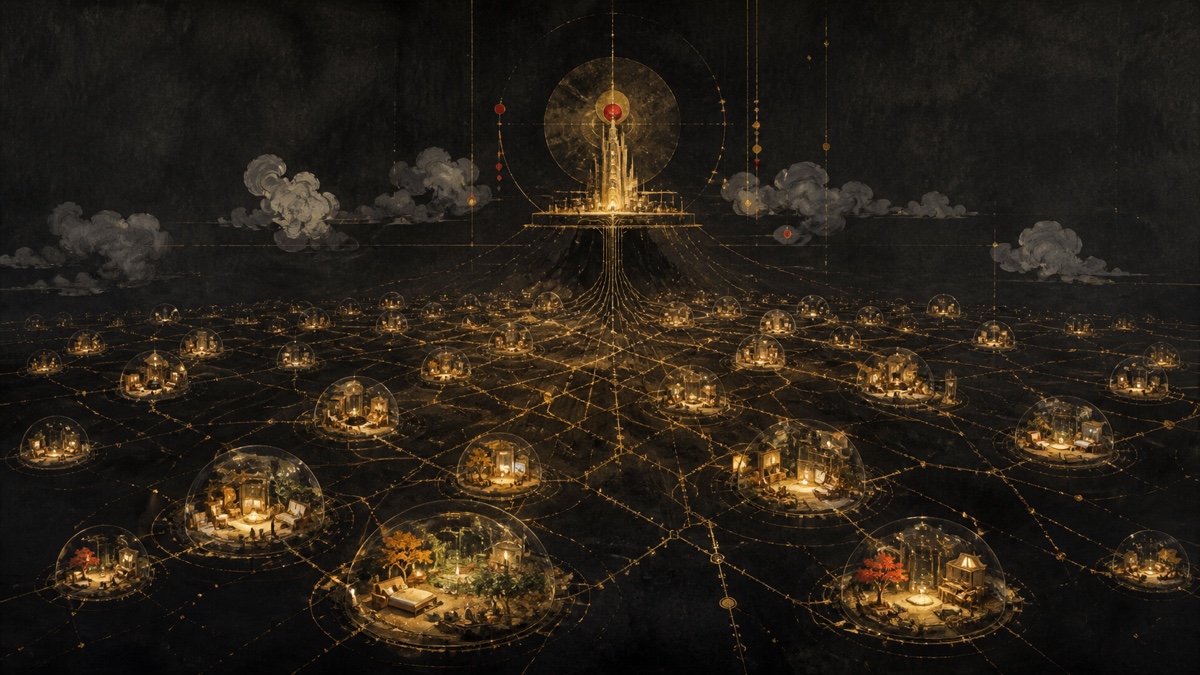
Abundance may be only a user interface
This future resembles the Matrix in the film of the same name.
The Matrix need not make people feel poor or miserable. It can give everyone comfort, entertainment, satisfaction and even a life tailored to them. The problem is not whether that experience feels good. It is that people live inside an interface provided to them without owning the system that creates the experience or deciding how it runs.
A vast increase in material supply can create this illusion of wealth. People receive a rich person’s consumption experience without gaining the assets, ownership or decision-making power that make the rich wealthy.
Most people then become users of an abundant system rather than owners of wealth. The future supports them; they do not own it.
They may live comfortably, but comfort is not freedom.
Happiness may depend more on relative wealth
There is a harsher, perhaps uglier, possibility here. Once basic needs and safety are secure, happiness may depend more on relative wealth than on absolute wealth.
Humanity’s absolute wealth has risen throughout history. Ordinary people now have access to healthcare, transport, communication, food and entertainment that even emperors once lacked. Yet this growth has not ended anxiety about status, class conflict, social discontent or the sense that life is unfair.
Perhaps that is because no one experiences wealth in a vacuum. We judge whether we are rich through comparison, social position, dignity, bargaining power and our sense of control over the future.
Absolute wealth answers:
How much can I consume?
Relative wealth answers:
What share of the total society do I have?
Where do I stand in relation to others?
How much control do I have over resources, rules, and the future?
Once basic living standards are secure, the satisfaction supplied by more material goods gradually diminishes. The dignity, anxiety, power and deprivation tied to relative position do not disappear with it.
If everyone’s material standard of living rises tenfold while the wealth and control of a small minority rise a thousandfold, most people may live better without feeling richer, happier or freer.
Universal high income is not wealth redistribution
Musk spoke in the interview of "universal high income." He suggested that when goods and services grow faster than the money supply, governments can distribute money directly to people. That could guarantee a basic level of consumption. But it changes the flow of income first, not the stock of assets.
Income is a resource the system gives someone at intervals. Ownership is the share that person holds in the system itself. Income can keep people from going hungry. Ownership determines whether they take part in future allocation and decisions.
If a small group owns every automated production system while everyone else receives only the income it dispenses, society may eliminate absolute poverty in its traditional form and still contain extreme relative poverty and inequality of power.
The real question is ownership, not abundance
So it is more accurate to say this:
An immense supply of goods may remove some material signs of poverty. It will not automatically dismantle the relative structure of wealth.
It may even make the wealth gap harder to see. Everyone lives better than before, creating a shared impression of prosperity. Meanwhile, a small minority owns a larger share of the productive system and gains greater power over society.
Absolute wealth determines whether someone can live comfortably. Relative wealth determines their place in the distribution of resources and power. Technology can improve the first. The second changes only when shares of wealth and the structure of ownership change too.
Musk’s imagined future may not be wrong. But he has described the productive conditions for abundance, not the social conditions for equality.
The future we should fear may not be one of widespread poverty, but of extreme inequality beneath widespread comfort: everyone can get what they want, yet only a few own the world that makes it all.